The Meeting I Almost Missed with a Baltimore Legend
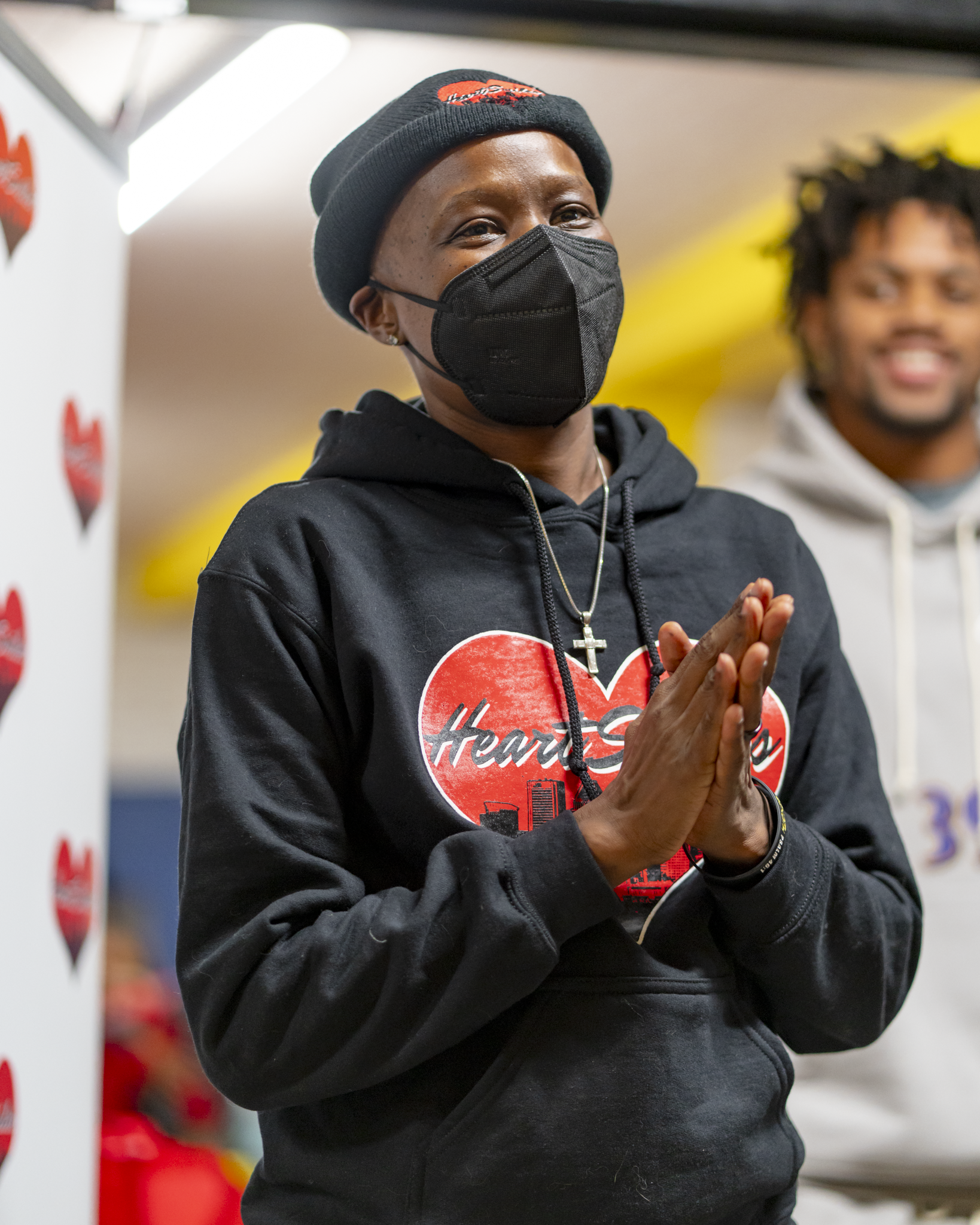
Dear Joni,
Inside the HeartSmiles headquarters, in a large room where young people from across Baltimore were gathering for programming, I saw a student I formerly taught in attendance.
“What school you at now?” I asked.
“I’m at City,” which I was pleased to hear. One of Baltimore’s elite public high schools, City was also my dad’s alma mater.
“How did you get here? Does the program provide a shuttle?”
“No, I caught the bus,” she responded. “Most of us do.”
There were high school students from various parts of the city in attendance, and all of them used public transportation, in a city with a notoriously unreliable public transit system, to get to this building to participate in this organization I’d just learned of. The difficulty of navigating the city by bus was not limited to getting to programs like this one.
Recently, a Baltimore Banner investigation into students’ school commutes found that nearly 60 percent required at least one transfer, putting data behind a transportation challenge Baltimore students had been navigating for years. I dealt with the same issue when I was in highschool.
I had to know more. I had to know why they wanted to make the trek, some of them from way across town.
But I almost didn’t make it into that room. Before I knew anything about HeartSmiles, before I knew you, Joni, there was one name attached to the opportunity that made me question whether I wanted anything to do with it: Michael Bloomberg.
The Michael Bloomberg name carried no positive merit in my life and still doesn’t. The former mayor of New York City presided over an era in which the NYPD’s stop-and-frisk practices were found to violate constitutional rights and engage in racial profiling. In twelve years, his police officers recorded more than five million stops, most of them involving Black and Latino people, with the overwhelming majority resulting in neither an arrest nor a summons. This dehumumanizing tactic tarnished his name for many, including me, an early-career professional working in education and human services back in 2018.
So, when my employer, Thread, came to me with the idea of connecting with an organization connected to Bloomberg's philanthropic arms, I was confused. Morally, it made no sense. Those arms were not ones that I believed comforted; rather, they circumvented and castrated Black and Brown people caught in their grasp.
I remember going directly to a leader in my organization and asking, “Why would we want the name of our organization to be connected with that of the disgraced former mayor?” Once the words permeated from my mouth, tension entered the room like an unwanted guest. Eyebrows rose, forehead skin wrinkled, lips clenched. With a peculiar look, the white director looked at me like I was Huey P. Newton and had asked her to support me in leading the revolution.
“It’s just a meeting,” was all she could muster.
Later in the day, one of my closest coworkers, Neekta, a Persian woman, notable champion for young people, and charismatic voice, talked to me about the opportunity to connect with the org Bloomberg was sponsoring, HeartSmiles.
“Let’s just check it out to see what they’re talking about,” she said.
I agreed with her thought about networking and using it as a learning opportunity rather than an agreement to partner, still cautious of the connection. Eventually, we made our way to your headquarters, inside of a Hopkins building, not too far from where I spent my teenage years attending Paul Laurence Dunbar High School.
The meeting was not the normal sit-down corporate chit-chat I was used to. Those meetings were filled with artificially manufactured laughs, awkward handshakes, and surface-level small talk. This was different.
We shook hands, chatted a little about the landscape of youth programming in Baltimore, and you, with black frames and a charming smile, ushered us into the large room where the youth were preparing for programming—the same room where I saw my former student.
Arriving on time with heads high and energetic like athletes preparing to compete, they walked in a way that owned the expectation of being there on time, regardless of the systemic barriers impeding them.
Next, while sitting along a long wall in a room full of about 20 students and a few staff members, Neekta and I waited for you or another one of the staff members to stand in front of the youth to bring the meeting to order, which was typical amongst youth orgs. I was used to youth being a little restless and being commanded by adults to acclimate to the programming. That was not this, though. A few words were said by one of the adults in the room, and the youth instinctively stepped into their positions. You sat waiting and watching. Your gaze was as silent as the G in “lasagna” that Lil Wayne rapped about, but it carried an unmistakable expectation for young people to be excellent.
The youth shifted into small groups, updating each other, making sure each member was briefed on what they were sharing out that day. Then, each group went up before everyone, one by one, to provide an update on research they had done, data they had gathered, insight they had learned, and people they had spoken to.
“Neekta, we have to figure out how to do this with Thread,” I said, leaning over and whispering near the end of the first group’s presentation.
“Oh my God, yes we do,” she responded.
Adults leading youth orgs command and dictate to youth every day in Baltimore. I have been in buildings full of yelling staff and disinterested youth on so many occasions. This approach to youth leadership and ownership was refreshing.
Due to other obligations, we could not attend the full meeting, but I made sure to thank the staff and especially shake your hand. You carried the commanding aura of some mythical mob boss, only yours was rooted in righteousness rather than ruthlessness.
That was my first introduction to you, Joni.
Throughout my years of continued service to Baltimore youth, I continued to cross paths with you and the rest of the HeartSmiles team at conferences and other convenings, in and outside of Baltimore. And when the world was shaken by the devastation caused by COVID-19, you continued to lead virtually.
“Young Leaders, Good Morning Listen”...you would say before dropping some words of wisdom to the young generation, offering easily accessible knowledge to impact their development in short form, meeting them where they were. And I always loved when you would tell them that “No Broke Bum Energy” was allowed as you pushed them toward taking accountability for their learning and aspirations.
This standard, the standard we should have for all of our youth, was a mantra I kept in mind while also working with the young people I was serving at Thread and other organizations. Whether it was helping them navigate employment or gain access to other needs, I worked to empower them to have agency in all they engaged in. “You have to stop bluffin’ on your dreams,” I’d say, reminding them that nobody was coming to manifest success for them. They had to own their destinies and put in the work to make their college and career aspirations materialize.
And when my first book was published in 2020, when masks became commodities, gloves became gold, and people were sanitizing cereal boxes, we connected and you gave me a platform to connect with HeartSmiles youth via YouTube. I could have talked to you for hours that day, our passion lighting up the virtual classroom.
And when I needed assistance with showing my staff at Elev8 about the potential for youth leaders, you didn't hesitate to open your doors and invite us into your office to impart wisdom and allow us to take a tour of your programming. And of course, the youth were the tour guides and facilitators, as expected. For a while, I didn’t even see adults, outside of my team, while youth prepared for workshops, practiced speeches, and organized themselves.
Months later, I heard through the social media streets that you received a severe cancer diagnosis, and I followed your new Instagram page to stay informed of your journey. The C-word has taken so many people prematurely, so as optimistic as your words were, I knew anything could happen at any moment.
September 10, 2025, 12:08 p.m.
“Sending you love Joni! Let me know if there’s anything I can do to support you in your healing journey. You mean so much to the city.”
3:25 p.m.
“Awwww thank you so much Al. I appreciate you more than you know!”
I hoped the diagnosis shifted course and made its way back into the realms from which it came.
November 25, 2025, 1:49 p.m.
“Sending you a lot of love Joni.”
2:48 p.m.
“Receiving it all thank you sooooo much!”
Then, you and your family held a prayer over in Erdman Shopping Center. Wearing a mask, as was requested on the flyer, I cried as I listened to your testimony and saw the tearful eyes and distraught faces of so many who adored you. It was too packed for me to come up and give you a hug, so I closed my eyes, said a prayer, and left it at that.
On the way out, I saw an old coworker, Corey, shaken like he just left a funeral. I hugged him with as much intention as I could muster in the moment.
When I got word of your passing, I was thankful that your suffering was upended, even as so many of us, selfish in our ways, wanted you to stay here forever. But this physical life is so fickle. People come and go in this form. Your spirit and name are what remain forever, hovering around your family, friends, colleagues, and the young people you served, keeping us motivated to continue the fight to uproot systems and structures that hold our young people back.
Even as I watched your body at the viewing, all I could think about was your commitment to the youth of Baltimore, many of whom sat front row, heads low, trying to make sense of what felt senseless.
To say you were a hero for Baltimore youth would be an understatement. A legend feels like the only appropriate title to bestow upon your name. Legends transcend time and space, and their names remain forever echoed throughout history. That’s what I envision for you, Joni. And I'm thankful to call you that and a friend in the struggle to cultivate the souls of our young people.
The irony is that a meeting I didn’t really want to go to left me with a friend and colleague I never wanted to let go of. Maybe that is the Lord working in the mysterious ways the elders spoke of.
Wishing you legendary rest,
Albert